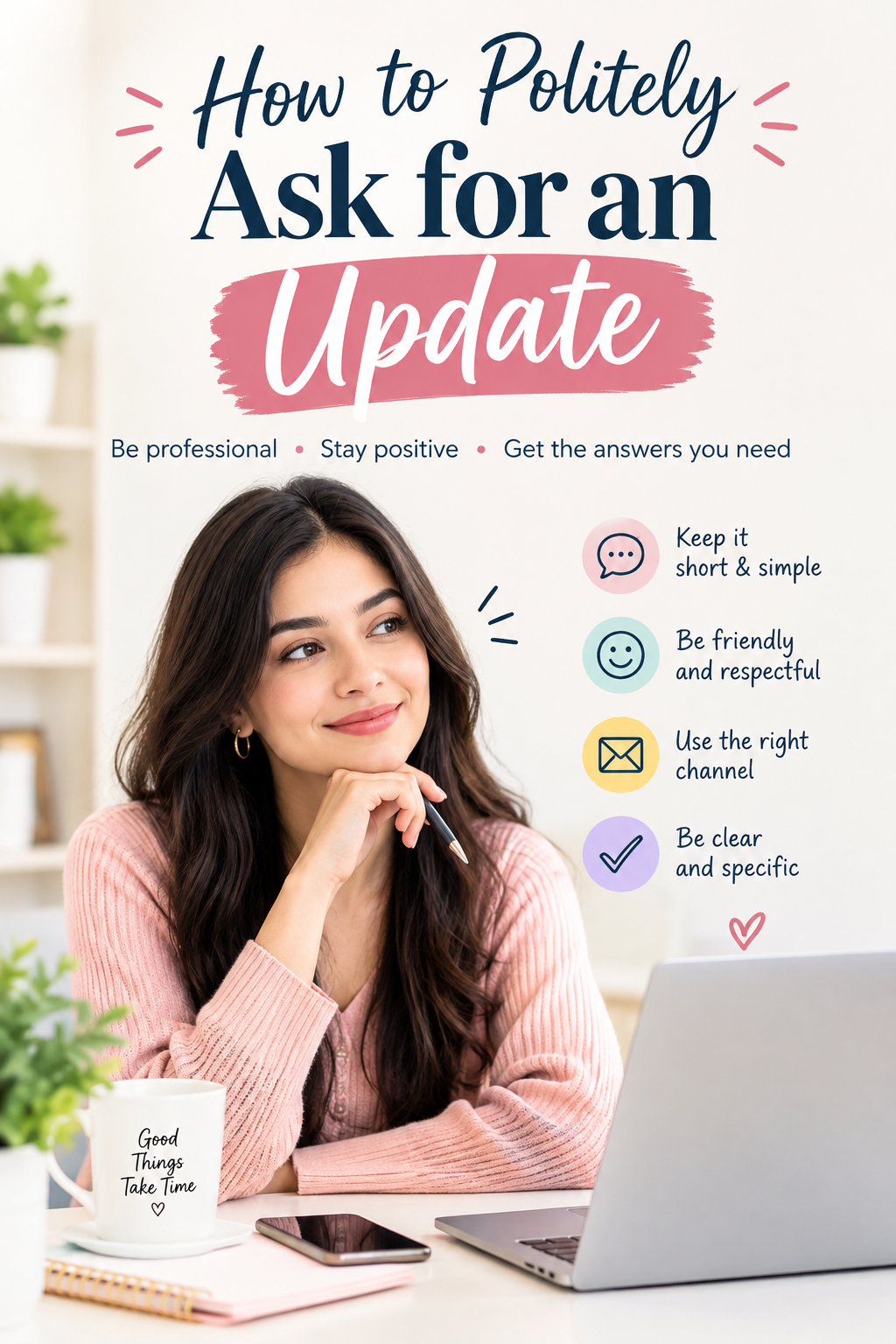
Sometimes, you need to know what is happening with a task, request, project, application, or email. You may want an answer, but you do not want your message to sound rude or demanding.
The way you ask can make a big difference.
A short message such as “Any update?” is common, but it may sound too direct in some professional situations. A more polite sentence can help you communicate clearly while showing respect for the other person’s time.
This guide explains different ways to ask for an update and when to use them.
Why Does Polite Wording Matter?
When you ask for an update, the other person may already be busy with several tasks. A polite message shows that you understand this while still making your request clear.
Compare these two messages:
Any update?
and:
Could you please let me know if there has been any update?
The first message is short and direct. The second sounds more considerate and professional.
You do not always need a long message. A few carefully chosen words can make your request sound much better.
Could You Please Share an Update?
This is a simple and polite option for professional communication.
Example:
Could you please share an update on the project?
You can use it with coworkers, clients, managers, or other professional contacts.
Could You Let Me Know If There Is Any Update?
This phrase is useful when you are waiting for new information.
Example:
Could you let me know if there is any update regarding my application?
It sounds polite without being overly formal.
I’m Following Up on My Previous Message
This works well when you have already contacted someone and have not received a response.
Example:
I’m following up on my previous message regarding the document.
You can then ask for the information you need.
I Wanted to Check on the Status
This is a natural phrase for work emails and messages.
Example:
I wanted to check on the status of my request.
It is useful when you want to know how far something has progressed.
May I Ask for an Update?
This is a respectful way to make a direct request.
Example:
May I ask for an update on the meeting arrangements?
It works particularly well in formal communication.
Do You Have Any Updates on This?
This is friendly and natural.
Example:
Do you have any updates on this?
It can work in workplace conversations, emails, and messages.
For a more professional tone, you can add the specific topic:
Do you have any updates on the proposal?
I’d Appreciate an Update When You Have a Chance
This wording is polite because it recognizes that the other person may need time.
Example:
I’d appreciate an update when you have a chance.
This can be useful when the matter is important but does not require an immediate response.
Could You Please Let Me Know the Current Status?
This is a good choice when you want specific information about progress.
Example:
Could you please let me know the current status of the order?
The phrase “current status” makes the request clear.
I’m Checking In Regarding…
“Checking in” is a friendly expression often used in professional communication.
Example:
I’m checking in regarding the report we discussed last week.
You can follow it with a question:
I’m checking in regarding the report. Do you have an update on its progress?
I Wanted to Follow Up Regarding…
This is another useful email phrase.
Example:
I wanted to follow up regarding my interview.
It is especially helpful when you are contacting someone again after an earlier conversation.
When You Have a Moment, Could You Update Me?
This phrase gives the other person some flexibility.
Example:
When you have a moment, could you update me on the project?
It works well when you want an update but do not want to sound demanding.
Could You Keep Me Posted?
Keep me posted means to continue giving someone new information as a situation develops.
Example:
Could you keep me posted on any changes?
This is useful for ongoing projects, plans, applications, and other situations where information may change.
Please Let Me Know If There Have Been Any Developments
This is a more formal option.
Example:
Please let me know if there have been any developments regarding the request.
“Developments” refers to new information or changes.
This phrase can work well in formal emails.
I’d Be Grateful for an Update
This has a polite and formal tone.
Example:
I’d be grateful for an update when convenient.
It can be appropriate when contacting someone you do not know well.
Could You Please Advise on the Progress?
This phrase is sometimes used in business communication.
Example:
Could you please advise on the progress of the application?
Here, advise means to provide information or guidance.
For a simpler style, you can write:
Could you please provide an update on the application?
The second version is often easier and more direct.
How to Ask for an Update by Email
A professional follow-up email does not need to be complicated.
A simple structure is:
Greeting
Start politely.
Hi Sarah,
Reason for contacting them
Briefly mention the earlier conversation or request.
I’m following up on the proposal we discussed last week.
Your request
Ask clearly for the information.
Could you please let me know if there has been any progress?
Closing
End politely.
Thank you for your time. I look forward to hearing from you.
This structure keeps the email short and easy to understand.
How Long Should You Wait Before Asking?
The right amount of time depends on the situation.
If someone said they would respond by a particular date, it makes sense to wait until that date has passed before following up.
For routine workplace matters, a short wait may be reasonable.
For urgent matters, you may need to follow up sooner.
Try to consider the other person’s deadline, workload, and the importance of your request.
What Should You Avoid?
Some follow-up messages can sound impatient even when that is not your intention.
Avoid messages such as:
Why haven’t you replied?
I need an answer now.
You still haven’t updated me.
These sentences may sound accusatory.
Instead, explain what you are following up about and ask for the information politely.
For example:
I wanted to follow up on my previous message. Could you please let me know if there has been any progress?
Polite vs Direct Examples
Here are some useful comparisons.
Direct
Any update?
Polite
Could you please share an update when you have a moment?
Direct
What’s happening with my request?
Polite
Could you please let me know the current status of my request?
Direct
Did you finish the report?
Polite
Could you let me know if the report is ready?
Direct
Why haven’t I received a response?
Polite
I’m following up to see if there is any update regarding my previous message.
Choosing the Right Phrase
Not every situation needs highly formal language.
| Situation | Suitable phrase |
|---|---|
| Coworker | Do you have any updates on this? |
| Manager | Could you please share an update? |
| Client | I wanted to check on the status. |
| Formal email | May I ask for an update? |
| Previous email | I’m following up on my previous message. |
| Ongoing project | Could you keep me posted? |
| Casual message | Any update when you get a chance? |
The best phrase depends on your relationship with the person and the situation.
Short Follow-Up Examples
Here are some complete examples you can adapt.
Project Update
Hi James,
I wanted to check on the status of the project. Could you please let me know if there has been any progress?
Thank you.
Job Application
Hello,
I’m following up regarding my application. Could you please let me know if there are any updates on its status?
Thank you for your time.
Client Request
Hi,
I wanted to follow up on my previous message. Please let me know if you have any updates when you have a chance.
Best regards.
Document
Hi Maria,
Could you please let me know if there is any update regarding the document? I’d appreciate it when you have a moment.
Thank you.
Final Thoughts
Asking for an update does not have to sound demanding. The key is to be clear, respectful, and specific.
Instead of sending a very short message such as “Any update?”, mention what you are asking about and use polite wording when the situation calls for it.
For professional communication, phrases such as “Could you please share an update?”, “I wanted to check on the status,” and “I’m following up regarding…” can help you sound respectful and professional.
The best message is usually the one that matches the situation. A quick question to a coworker can be simple, while an email to a client or manager may need a more formal tone.
